Here, I am zeroing in on a “smaller” topic regarding African Colonial Soldiers in World War II. This post is about recruitment.
Impact of WWII’s outbreak on African Civilians and Recruitment
Not only did the outbreak of WWII affect lives in Europe and Asia, but it also brought confusion and fear to African civilians, highlighting their crucial yet often-overlooked role in supporting Allied forces through extensive mobilization and significant sacrifices. September 1939 marked a pivotal moment in global history, significantly affecting every corner of the world. Despite a lack of knowledge of the true cause of the war, the colonial powers rapidly initiated the recruitment of African soldiers to bolster their military forces. From Uganda to Kenya, men from various tribes were mobilized, often under duress or through coercion, to serve in the Allied forces. This large-scale recruitment effort not only highlighted the colonial exploitation of African resources but also underscored the vital and often underappreciated contributions of African soldiers in the fight against Axis powers.
Scale of African Mobilization
The scale of African colonial soldier mobilization for World War II was unprecedented, involving hundreds of thousands of troops from across the continent who played crucial roles in various theaters of the conflict. For Colonial armies, say Killingray and Plaut, “recruits for the colonial armies were medically examined and only those of certain height (ideally 5ft8) physique, and standard of health were accepted […] The age of the recruit was of little consideration….” Because of these very specific rules among others, many men who actually wanted to participate were denied.

Soldiers of the 11th East African Division in Shwegyin, Burma, December 1944. Wikimedia Commons
Recruitment by Britain
For Britain, there were nearly 1,000,000 African Colonial soldiers, with 320,000 East African or Kings African rifle soldiers, 300,000 West African Soldiers (RWAFF, or Royal West African Frontier Force), 130,000 non-European South Africans, and those from islands like Mauritius and Seychelles. According to historian Headrick, “Under General Sir George Giffard, the RWAFF (Royal West African Frontier Force) grew from 50,000 in 1941, to 100,000 in 1942, to 150,000 in 1945” (Headrick, 503-504). Overall, more than 200,000 West Africans risked their lives under British command. In East Africa, participation in the armed forces was even higher. Approximately 325,000 East Africans served in both the KAR (King’s African Rifles) and various military labor units (Headrick, 504).
Recruitment by France
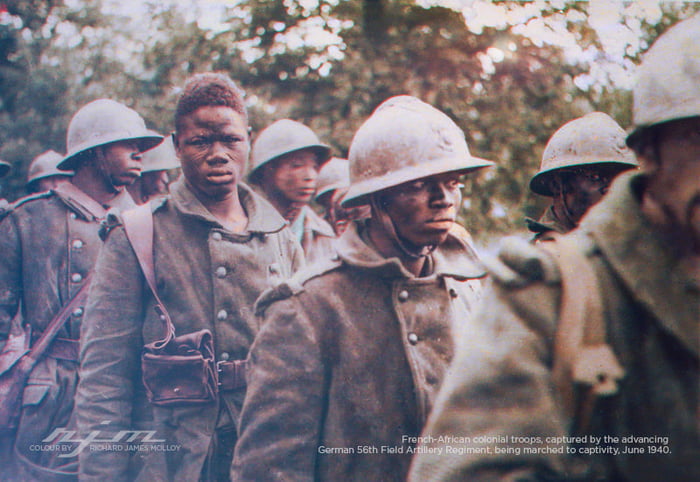
Historian John H. Morrow concurs, also stating in his article Black Africans in World War II: The Soldiers’ Stories, that “from 1939 to June 1940, the French Military called up approximately 300,000 North African and 197,000 West African men to join the war effort on the frontlines.” About 63,300 West Africans saw combat in France in 1940.” (Morrow, 14) “After the Allies invaded North Africa in 1942, France called up even more Africans to join the army, and almost half the Free French forces were African” (Headrick, 510).

French-African colonial troops, captured by the advancing 56th Field Artillery Regiment, being marched to captivity, June 1940.
Obtained From: https://9gag.com/gag/anMvVD5
Recruitment by Italy
The mobilization of African colonial soldiers by the Axis powers, specifically Italy, was substantial, with numerous troops being deployed in critical engagements across the North African front. As the only Axis power with colonies in Africa, Italian recruitment of African colonial soldiers during World War II primarily focused on its colonies in East Africa, namely Eritrea, Somalia, and Ethiopia. Italian colonial forces, known as the Ascari, were composed of native soldiers who had been serving under Italian command since the early 20th century. Recruitment practices varied, with some soldiers joining voluntarily due to promises of steady pay and benefits, while others were coerced or conscripted by local authorities. The Italian military utilized these troops in various capacities, including as front-line soldiers, support units, and labor forces. The collapse of Italian East Africa in 1941 following the British-led East African Campaign significantly disrupted the use of African soldiers by Italy, and many Askari were either captured or disbanded.

Kenyan soldiers, or the King’s African Rifles, training in the bush, Kenya, 1944. Wikimedia Commons
Historical Neglect
The legacy of these soldiers, like their French counterparts, has often been neglected in historical accounts of the war. The mobilization of African colonial soldiers during World War II was a massive and critical effort that highlighted the significant yet often underappreciated contributions of these individuals. Understanding the extent of their involvement sets the stage for examining the wartime experiences of colonial soldiers, shedding light on their roles and sacrifices on the front lines and beyond, which shaped both the outcome of the war and the post-war period.
 WORLD WAR II'S UNSUNG AFRICAN HEROES
Leave a comment