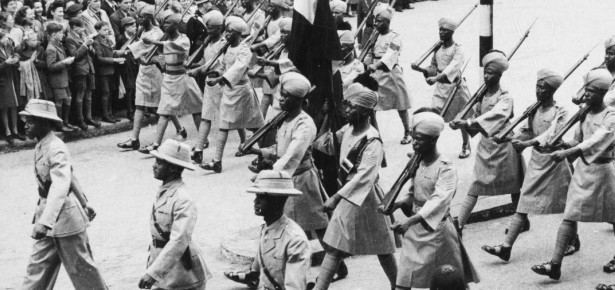
After the war, it is unclear what African veterans did, and many still ask the question: did their service in the war end have any benefits for them?
A lot has been written about how WW2 was the beginning of the end of the colonization of Africa. Two new superpowers emerged after WW2. They were the USSR and the USA, while the main colonial powers in Africa, Britain and France, had declined in political and economic power. Within 20 years of the end of WW2 (1951-1965), almost 40 African countries gained their independence. This is a large majority of African countries, even now there are 55 countries in Africa.
Did these returning soldiers play any role in transforming the political landscape on the continent when they returned? Did their service in the war provide any real benefit to them and their countries?

Soldiers from the French African colonies holding a position at Boucle du Doubs, near Besancon, France, winter of 1944. https://rarehistoricalphotos.com/black-soldiers-fighting-france-1944/
The Traditional Opinion
It has been written that, because of the war, “the myth of colonial invincibility was destroyed, and the self-confidence of the colonial powers and administrators who sustained the myths dissipated. The colonial emperor had no clothes.” (Michael Crowder, The Cambridge History of Africa, Vol. 8: From c 1940 to c 1975 (1984), p. 21). Also, the report of a committee in the Gold Coast (now Ghana) in 1949 said that the soldiers, “having fought in the defense of freedom, they considered it their right that they should have some share in the government of their land. These ideas quickly spread throughout the whole country”. (Gold Coast: Report to His Excellency the Governor by the Committee on Constitutional Reform 1949, Colonial Paper No. 48), paragraph 25). In a booklet entitled “An African Soldier Speaks” written in 1944 by a soldier called Robert Kekembo, which was banned by the Colonial Office in London, made some proposals about the colonial system and how it needed to change. The Colonial Office allowed 400 copies to be printed for distribution to colonial officers primarily to warn them about the kind of ideas that educated East African soldiers might have.
Changing Views
Contrary to popular belief, more recent research has shown that the impact of these soldiers in political movements and political change was limited. Some of them were active in political parties and trade unions, using ideas they came across abroad during the war, but most of them went back to their rural communities when they returned, and focused mainly on their own personal interests and their own lives, families and communities. Most of the educated and literate soldiers and those who were skilled found jobs after the war and were not focused on being nationalistic. Some even found work in the colonial administration, for example as policemen or clerks. When they were active, they often challenged the failures of the government to provide support and services to help former soldiers. They were more focused on their own well-being, and economic situation. Hargreaves wrote ”most of the groups and individuals whose horizons had been widened by wartime mobilization remained primarily concerned to defend or advance their own economic interests or cultural values; political consciousness was not born in nationalist costume” (John D Hargreaves, Decolonization in Africa (1996), p. 74). One writer has written that, among educated African veterans, “disillusionment with their lot in the postwar world did not did not necessarily lead to overt political action”. (Killingray, p.217).

Soldiers of the King’s African Rifles rest in the sun during the advance into Italian-controlled Somaliland, Feb. 13, 1941.
Wikimedia Commons: https://allthatsinteresting.com/african-soldiers-world-war-ii#18
Despite what we know, it is not clear whether the returning soldiers were able to change their countries’ political situation when they returned. We cannot state that their service had any positive effect on them personally or on their countries by helping them achieve self-determination but their experience when they came home still shows that the label of “unsung heroes” still applied to them.

Askaris (local soldiers) during shooting practice in German East Africa – now Tanzania https://www.bbc.com/news/magazine-33329661
SOURCES
https://www.thoughtco.com/chronological-list-of-african-independence-4070467
David Killingray, Fighting for Britain: African Soldiers in the Second World War (2010). Chapter 7.


Leave a Reply