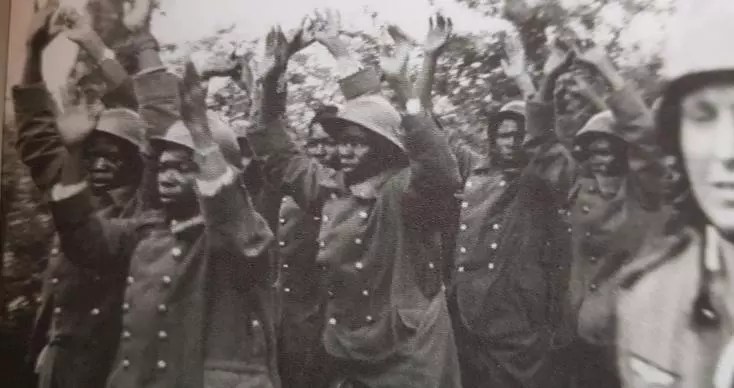
Realities of Military Service: Part III Disparities in the treatment of African Prisoners of War
German forces subjected African colonial soldiers, primarily from French West Africa (Senegal, Mali, Burkina Faso, and Niger), to especially brutal treatment during their captivity in World War II. These soldiers fought for the French colonial army in units such as the 24th Regiment of the Senegalese tirailleurs and were captured during the 1940 Battle of France. Near Cavillon, German soldiers executed wounded African troops on the battlefield. As Édouard Kouka Ouédraogo, a soldier from Burkina Faso, recounts, “The wounded are finished off on the field.” He describes how guards killed African soldiers on sight and beat others with rifle barrels. During forced marches, guards placed African soldiers at the back of the columns, behind white French and North African troops, and regularly denied them food and water. Those who slowed down or tried to drink from puddles were shot.[i]
While all POWs suffered harsh conditions, the Germans treated white French soldiers less violently. White prisoners lived in the barracks, but guards left African prisoners in open fields with no shelter. Joseph Julien Dache, a white French POW at Romilly-sur-Seine, describes how African soldiers were left exposed, saying, “The camp, if it can be called that, was a lawn surrounded by barbed wire… There was no shelter.” Guards ridiculed African soldiers, associating them with barbarism, and used propaganda to justify their mistreatment.[ii] In June 1940, as Nazi forces advanced through France, African soldiers, mainly from Senegal, were captured alongside French troops. Influenced by racist propaganda, German soldiers viewed them as inferior. While white POWs were sent to camps, Senegalese riflemen were often separated and executed, including at the Chasselay Massacre, where they were machine-gunned by German tanks on the 19th and 20th of June 1940 in the region of Lyon.[iii] Survivors were held in Front-Stalags (German labor camps largely in north-eastern France), and faced starvation and forced labor to prevent so-called “racial contamination.”[iv] This violence due to race highlights how racism worsened the hardships African soldiers faced, both as colonial troops and as prisoners of war.[v]
66 Raffael Scheck, French Colonial Soldiers in German Captivity during World War II (New York: Cambridge University Press, 2014), 32–33.
67 Scheck, “French Colonial Soldiers,” 38.
68 Echenberg, “Morts pour la France,” 370.
69 Stéphanie Trouillard, “The Nazi Massacre of African Soldiers in the French Army, 80 Years On,” France 24, June 21, 2020.
 WORLD WAR II'S UNSUNG AFRICAN HEROES
Leave a comment