Tirailleurs
Image Source: https://mairie20.paris.fr/pages/1939-1945-memoires-des-tirailleurs-senegalais-30457
The Realities Of Military Service Part II : Battlefront Involvement and Impact
These experiences reveal the disproportionate sacrifices African soldiers made in securing Allied victories. Despite being conscripted under harsh and often discriminatory conditions, their involvement was crucial to the Allied war effort, and their contributions, though frequently overshadowed by narratives centered on European soldiers, were vital in shaping the outcome of one of the most significant conflicts in history.
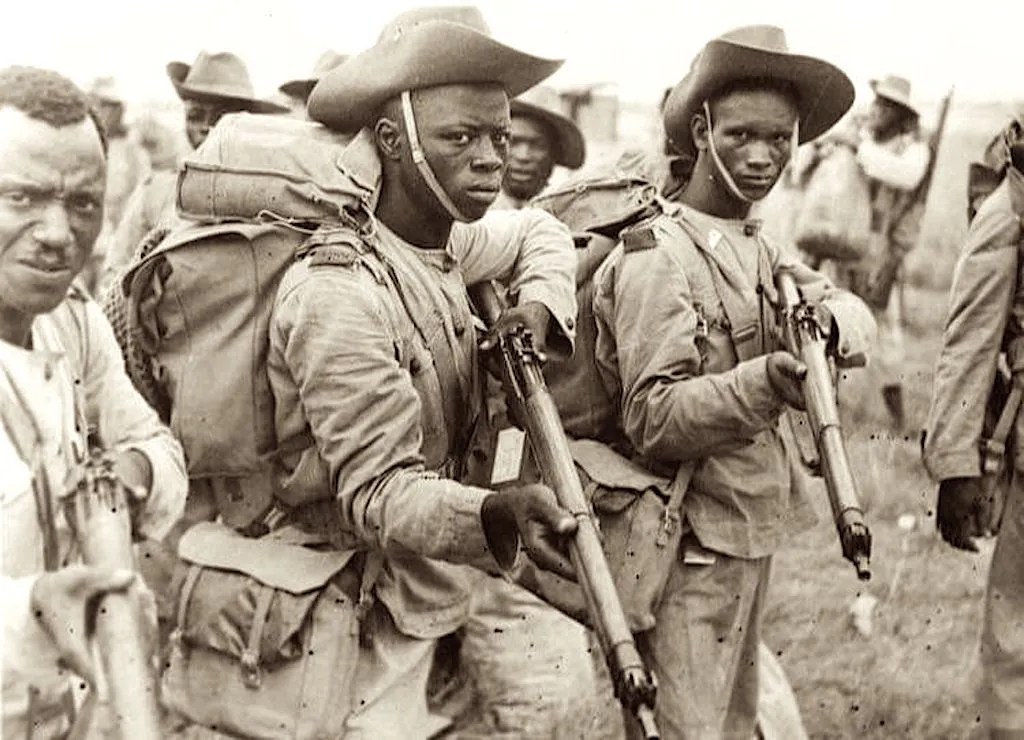
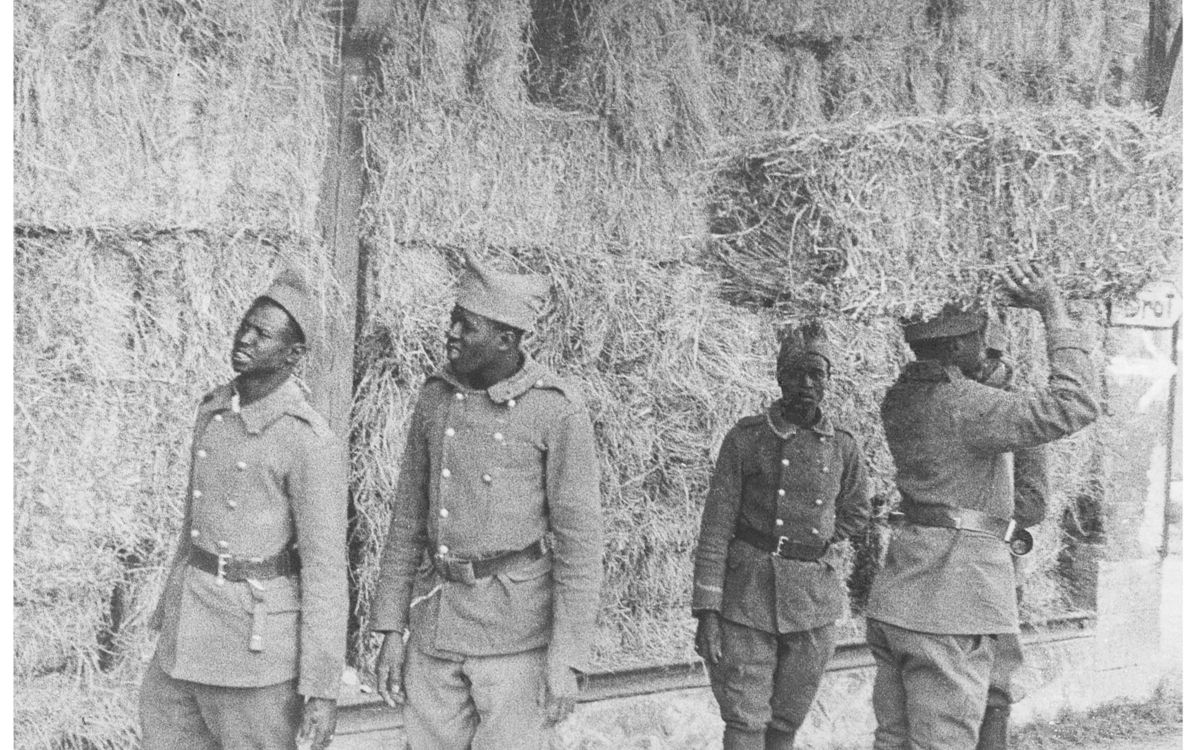
French colonial soldiers, often referred to as tirailleurs, were a critical component of French military forces during World War II. Recruited from mostly West Africa, these soldiers were key in campaigns such as the Battle of France in 1940, the Battle of Bir Hakeim in 1942, and the Provence landings in 1944. They also played major roles in the Italian campaign (1942–43) and the liberation of southern France. Tirailleurs faced racial discrimination and were often sent to the most dangerous frontline positions by the French.[i] As stated above, from 1939 to June 1940, the French military called up approximately 300,000 North African and 197,000 West African men to join the war effort on the frontlines. About 63,300 West Africans saw combat in France in 1940.[ii] Without these tirailleurs, it is unlikely France would have survived for as long as it did. The French recruited 179,000 tirailleurs, and some 40,000 were deployed to Western Europe. Many were sent to bolster the Maginot Line along France’s border with Germany and Belgium during the German invasion of 1940, where many were killed or taken prisoner. After the fall of France, others served in the Free French army in Tunisia, Corsica, and Italy and in the south of France during the liberation.
African colonial soldiers’ role in the British Army should not be taken lightly either. Under General Sir George Giffard, the RWAFF expanded from 50,000 in 1941 to 100,000 in 1942 and to 150,000 by 1945.[iii] These colonial soldiers participated in key World War II campaigns across various theaters, including the pivotal Battle of El Alamein in North Africa. Ironically, despite serving as central roles in campaigns such as El Alamein and Bir Hakeim, they were largely absent from later victory parades and historical narratives.[iv]
Members of the Forgotten Army
African colonial soldiers played a critical role in the Burma campaign during World War II. This campaign involved intense battles in the British colony of Burma (now Myanmar) as part of the China–Burma–India theater, often called the “Forgotten War.” These soldiers were part of the British Fourteenth Army, known as the “Forgotten Army,” which fought in harsh jungle conditions in 1944 and 1945 with little recognition back in Britain. About 120,000 African soldiers, mainly from British East and West Africa, were sent to Burma in 1943. Their ability to adapt to the monsoon climate was an advantage, as they suffered fewer illnesses than European and Indian troops.[v]
West African soldiers, primarily from the RWAFF, were central to the successes of the Burma campaign. The 81st and 82nd divisions achieved major victories. The 81st division captured strategic locations such as Mandalay and Myohaung, while the 82nd division played a key role in the Third Arakan campaign, capturing Dalet Chaung and Tamandu in early 1945, despite suffering heavy losses. Together, these divisions pushed Japanese forces back and helped secure Allied positions in the region.[vi]
Nigerian troops were among those who fought against the Japanese in Burma, enduring tough jungle conditions and proving themselves in some of the hardest battles. One account described their success, saying, “Many of the soldiers came from technologically very backward groups – most were illiterate on recruitment. Yet they fought with modern weapons against a fanatically brave enemy in strange and appalling conditions with such success that both the Japanese enemy and British commanders had the highest regard for them.”[vii] Their achievements were praised by Admiral Lord Louis Mountbatten, the Supreme Allied Commander in Southeast Asia, who led the fight against Japan in the region. After the fall of Rangoon, Mountbatten said, “You have won the race for Rangoon and beaten the monsoon as well as the Japanese.”[viii] Nigerian soldiers overcame huge challenges and earned respect for their courage, adaptability, and vital role in the Allied victory.
Nigerian soldiers also showed incredible skill and bravery, especially in the East African campaign. In East Africa, the 23rd Nigerian Infantry Brigade, made up of the 1st, 2nd, and 3rd battalions, played a major role in defeating Italian forces. They defended the Mabungo bridgehead, captured an entire Italian battalion, and took thousands of prisoners. Their efforts helped liberate Addis Ababa and led to the capture of 10,000 Italian soldiers in Dire Dawa.[ix] British African forces “enjoyed overwhelming success” in the Ethiopian campaign, taking Addis Ababa in two months, during which time they covered an average distance of 76 miles per day.[x]
In many cases, African soldiers were placed directly on the front lines, often becoming the first to be shot while protecting the European men. They were given minimal training and equipped with substandard supplies compared to their European counterparts.[xi] Even as they proved their effectiveness in combat, they were consistently denied equal treatment and recognition.
55 Echenberg, “Morts pour la France,” 363.
56 John H. Morrow, “Black Africans in World War II: The Soldiers’ Stories,” The Annals of the American Academy of Political and Social Science 632 (2010): 14.
57 Headrick, “African Soldiers,” 503–504.
[iv] Morrow, “Black Africans in World War II,” 16–17.
59 Oliver Coates, “New Perspectives on West Africa and World War Two,” Journal of African Military History 4, nos. 1–2 (2020): 19.
60 Coates, “New Perspectives,” 19, 21–23.
61 Mordi, “Recruitment of Nigerians,” 279.
62 Mordi, “Recruitment of Nigerians,” 303.
63 Mordi, “Recruitment of Nigerians,” 301.
 WORLD WAR II'S UNSUNG AFRICAN HEROES
Leave a comment