Part 1: Life in the Ranks
For many young men in Africa, specifically British colonies, the Second World War was a time of adventure and opportunity. It was the first time many had worn boots or ridden in a motor vehicle. However, these novelties were quickly overshadowed by brutal treatment, discrimination, and the horrors of war. The experiences of African colonial soldiers revealed the deep injustices they endured both during the conflict and in its aftermath. Widespread discrimination, severe underpayment, and front-line hazardous posting during the war foretold how little the colonial powers would later value African veterans when the war ended.
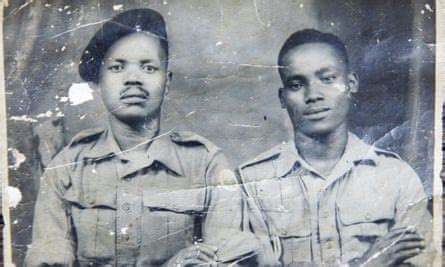
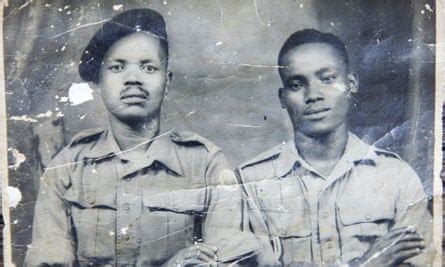
One such soldier, Eusebio Mbiuki, was shipped to Burma in 1944 to fight the Japanese Imperial Army for the British. He described appalling conditions, including rampant disease and the constant presence of death. “We started fighting the Japanese straight away,” said Mbiuki. “While we were looking for each other there would be gunfire. Then we would run towards it. It was really rough.” (Image above:Mr Mbiuki (left) as a soldier in the 1940s Credit: Jack Losh/Jack Losh)
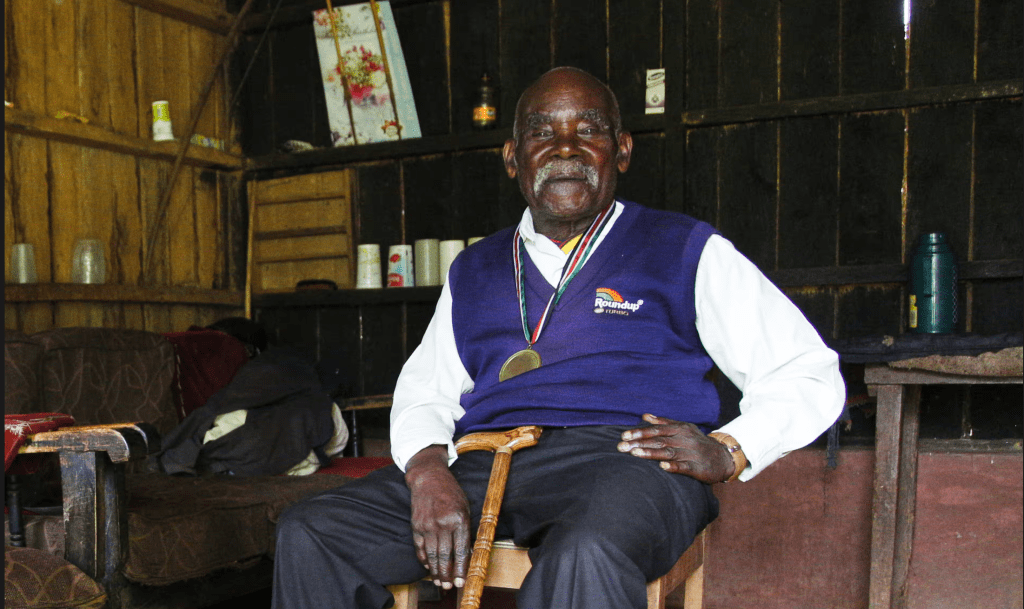
Eusebio Mbiuki, 100, who served in Britain’s Burma campaign says he was frequently beaten by officers. Photograph: Jack Losh
Similarly, 96-year-old Mzee Gichanga Kibicho recounted how soldiers like him were conscripted, and forced to carry heavy loads. Another veteran, 98-year-old Joseph Hinga, shared memories of brutal treatment by British officers during the Burma campaign: “We used to be whipped with a whip made out of rhino hide… We used to be tortured to show that we were lesser men.”
Mbiuki echoed these experiences: “They beat us, they beat us a lot. Our bodies became so swollen from the beating. They would beat us and slap us a lot…they were told to beat you, to really beat you.” Rules around discipline and punishment often targeted African soldiers more harshly than their white counterparts; and in the view of these veterans, this abuse arose from systemic racism. As Killingray put it, it was based on “the idea that child-like people needed to be schooled and disciplined with physical force, the stick or whip was convenient, instant and closely related with the offence … It was, so its advocates argued, readily understood by Africans; coming from societies that inflicted brutal punishments on offenders, Africans clearly recognized, and indeed expected, physical abuse as the reward for misdemeanours. And in any case, it was argued, they had an ability to bear pain, ‘which the primitive African does not feel’.”
They also endured more direct racism such as that described by a Takoradi veteran from Ghana from the British: “In the army, the white people were not treating most of us well. They were kicking us, calling us ‘you black monkey’, and so forth… We didn’t like the way they were treating us, especially when we went to Burma and all those places.” This treatment was part of a larger pattern of discrimination that devalued African soldiers even as they were relied upon in war.
While in the army, their pay was also less than an European of the same rank. The British authorities in the Gold Coast ( now Ghana) admitted that Europeans were paid higher wages but justified the lower pay for Africans by claiming it was still better than the average earnings of civilians in the Gold Coast. They argued that, with food and housing provided by the army, African soldiers enjoyed a higher standard of living compared to civilian workers, essentially comparing their wages to those of African laborers. In addition, while the pay for Africans remained the same, Europeans received increases during the war. Similarly, in South Africa, white soldiers were paid twice as much as the soldiers who served in the Cape Coloured Corps and the Indian and Malay Corps, and were paid even less.
Nigerian soldiers also faced significant inequities during their service. Colonial officers often prohibited from wearing proper footwear, forced to salute white civilians, and were also paid considerably less than British or Indian soldiers. Additionally, they were excluded from officer ranks due to the colonial belief that Nigerians lacked the refinement required for leadership. These policies were particularly frustrating for the educated soldiers who enlisted during World War II and expected more respect.
Sometimes, the situation for colonial soldiers was so dire that it led to mutiny. As General Sir William Platt, who controlled East African Command in December 1941, reported, “There have been numerous incidents in almost all Somali units, and some amongst Somali personnel attending courses at Command School. They have generally taken the form of refusal to obey orders, sit-down strikes, shouting, desertion with weapons, untrustworthiness as guards, collusive theft, occasional stone throwing and drawing of knives,…”. These acts of defiance reflect the unbearable conditions these soldiers endured.
These experiences reveal the disproportionate sacrifices African soldiers made in securing Allied victories. Despite being conscripted under harsh and often discriminatory conditions, their involvement was crucial to the Allied war effort, and their contributions, though frequently overshadowed by narratives centered on European soldiers, were vital in shaping the outcome of one of the most significant conflicts in history.
Sources
Grundlingh, Louis. “Aspects of the Impact of the Second World War on the Lives of Black South African and British Colonial Soldiers.” Transafrican Journal of History 21 (1992): 19–35. Accessed June 8, 2024. http://www.jstor.org/stable/24520418.
Hargreaves, John D. Decolonization in Africa. London: Routledge, 2014.
Headrick, Rita. “African Soldiers in World War II.” Armed Forces & Society 4, no. 3 (1978): 501–26. Accessed June 8, 2024. http://www.jstor.org/stable/45346089.
Israel, Adrienne M. “Measuring the War Experience: Ghanaian Soldiers in World War II.” The Journal of Modern African Studies 25, no. 1 (1987): 159–68. Accessed January 8, 2025. http://www.jstor.org/stable/160973.
Killingray, David. “Military and Labour Recruitment in the Gold Coast During the Second World War.” The Journal of African History 23, no. 1 (1982): 83–95. Accessed June 8, 2024. http://www.jstor.org/stable/181272.
Killingray, David. “Labour Exploitation for Military Campaigns in British Colonial Africa 1870-1945.” Journal of Contemporary History, Vol. 24, No. 3 (1989): 483-501Accessed December 19, 2024.
http://www.jstor.org/stable/260671.
Killingray, David. “The ‘Rod of Empire’: The Debate over Corporal Punishment in the British African ColonialForces, 1888-1946.” The Journal of African History, Vol. 35, No. 2 (1994): 201-216. Accessed January 20, 2025. http://www.jstor.org/stable/183216
Killingray, David, and Martin Plaut. Fighting for Britain: African Soldiers in the Second World War. Suffolk, UK: Boydell & Brewer, 2010.
Killingray, David. “African Military Migration in the First and Second World Wars.” Migration in Africa, 2022, 311–29.
Losh, Jack. “Britain’s Violent Conscription of African Soldiers Is Finally Coming to Light.” New Statesman, March 4, 2019. Updated September 9, 2021. Accessed December 17, 2024. https://www.new.com/politics/2019/03/britains-violent-conscription-of-african-soldiers-is-finally-coming-to-light.
Losh, Jack. The Forgotten Heroes of Empire. The Guardian/AlJazeera, February 13, 2019. Accessed January 28, 2025. https://www.aljazeera.com/program/people-power/2019/2/13/the-forgotten-heroes-of-empire
Lunn, Joe. “Africans in World Wars I and II.” Oxford Research Encyclopedia of African History. 26 Mar. 2019; Accessed January 31, 2025. https://oxfordre.com/africanhistory/view/10.1093/acrefore/9780190277734.001.0001/acrefore-9780190277734-e-42.
 WORLD WAR II'S UNSUNG AFRICAN HEROES
Leave a comment