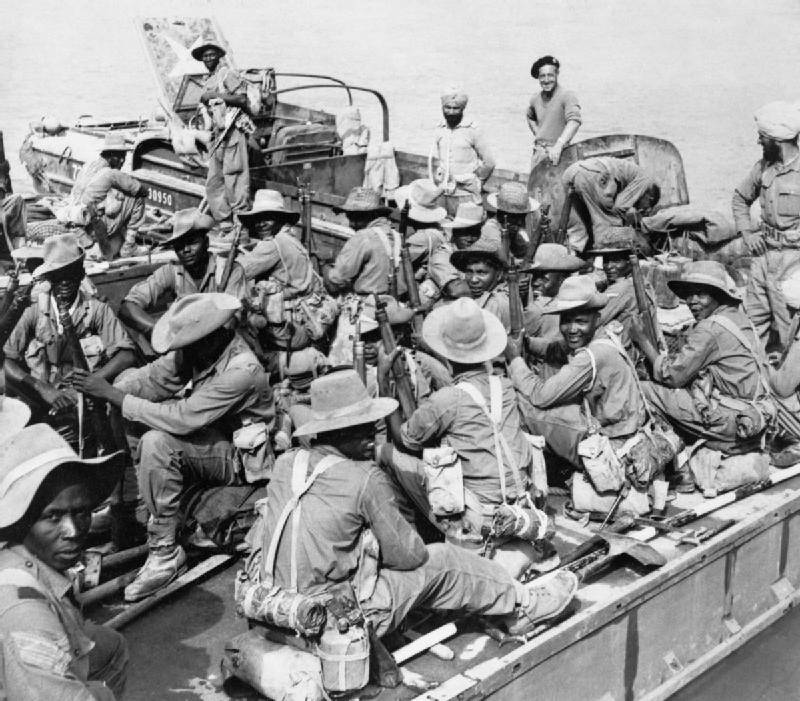
Revisiting the topic of recruitment from a previous post, as the factors behind African colonial soldiers’ enlistment remain a subject of debate.
While some historians emphasize the economic benefits of military service, others highlight coercion, arguing that colonial authorities manipulated economic instability and governance systems to maintain recruitment levels.
These perspectives are not mutually exclusive but instead reveal how coercion and opportunity were deeply intertwined.
Recruitment
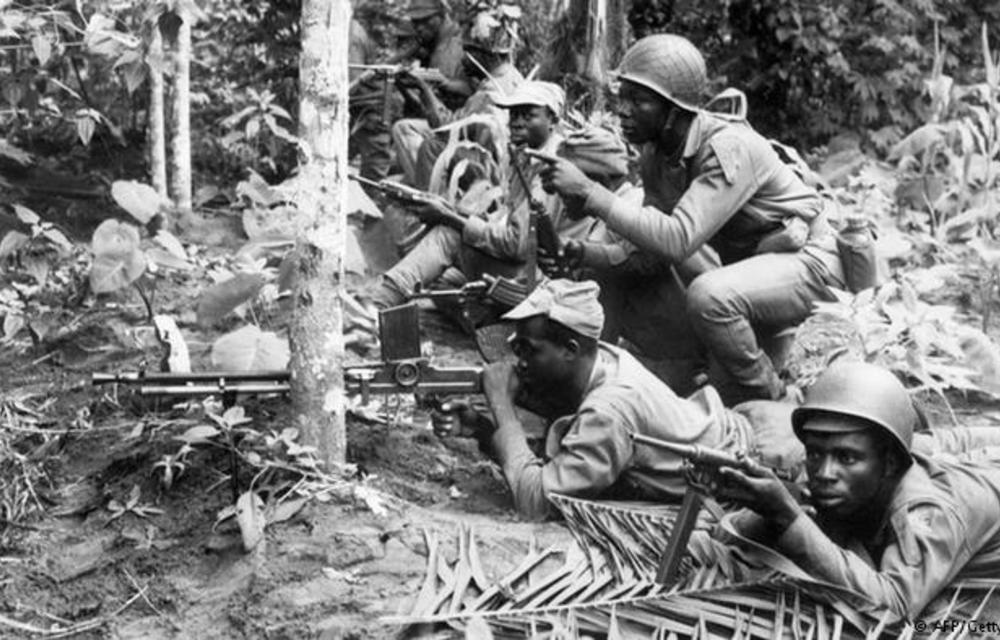
In the years leading up to World War II, European colonial powers had already drained significant resources from their African colonies. But as war loomed, they needed more than resources—they needed soldiers. The weakened colonial economies, strained by high taxes, forced labor, and exploitative land policies, left many African men with no choice but to enlist in the war. The military often seemed like the only path to a better future. The promise of post-war benefits and the appeal to imperial loyalty were used to manipulate recruits, though the benefits rarely came. African soldiers enlisted during World War II for a combination of reasons, which included overt coercion, propaganda, economic necessity, and social pressures.
Direct Coercion and Force
Colonial administrators across Africa used a range of coercive methods to meet recruitment quotas. Chiefs in British colonies were required to supply a set number of men, under directives enforced by colonial officials, chiefs who failed to meet these quotas faced punishments such as fines, loss of privileges, or removal from their positions, creating a situation where they were forced to comply, often against the will of their communities. For young men, the prospect of forced enlistment loomed large, as refusal could result in severe repercussions for their families or communities.
Ebou Janha, a former Gambian soldier, recalled being taken by village elders in 1941 at just 22 years old and being conscripted into the British army and sent to fight in a war he barely understood. He recalls that his chief chose him because of his physique and his stubborn attitude; he was tied up with ropes to stop him from escaping until he accepted that he was being forced to go to war. In the Gambia, soldiers were conscripted under a quota imposed on local chiefs by the British colonial authorities. The chiefs were required to provide 30 recruits each month, and that number increased to 75 in 1943. The recruits were sometimes conscripted by rounding up unemployed men in the capital city.
In other British colonies like Nigeria and the Gold Coast (modern-day Ghana), recruitment depended heavily on local chiefs. Colonial administrators required chiefs to meet quotas set, but this often created tension within their communities. Chiefs who failed to deliver the required number of recruits faced harsh punishments such as fines, loss of privileges, or dismissal from their roles. These pressures strained relationships between chiefs and their people. For example, Killingray describes how many chiefs resorted to using fines, intimidation, and even imprisonment to meet quotas, making them deeply unpopular in their communities. In some cases, chiefs were placed in morally compromising positions. Oral histories from Nigerian recruits reveal how families sometimes viewed chiefs as collaborators in the colonial system, blaming them for the forced conscription of young men. This often caused problems within local communities, with some chiefs losing the trust and respect of their people. Local chiefs sometimes had people conscripted for personal reasons, and in one case, an illiterate recruit complained that his chief sent him to the recruiters with a letter saying he wanted to be a soldier because the chief wanted his girlfriend.
Deception frequently accompanied coercion in British East Africa. In 1943, at just 17, Gershon Fundi from Kenya trusted a local administrator’s offer of a communications job. Desperate for work, he reported to the assigned location, only to find himself in the military. “When I got there that’s when I realised I was in the army,” he said at age 91. He was barred from leaving, forced to sign a contract and was sent to Ethiopia and Somaliland as a signalman. Such stories highlight the manipulation and exploitation that characterized British recruitment practices.
In French colonies, most African soldiers and laborers were forced to join, except for a few who enlisted willingly, such as young men seeking to prove their bravery, or Senegalese recruits seeking recognition as French citizens. While recruitment methods varied, coercion played a central role. Many African families had no choice but to send one son in order to meet colonial quotas imposed by the colonial authorities, often making painful decisions to protect their households. For example, Sera Ndiaye, a Senegalese recruit in 1916, recalled how he was chosen by his father to serve so his older brother could stay and care for the family. French authorities regularly raided villages, forcing young men into military service and breaking up families. Ivory Coast veterans recounted the hardships they endured. Djirigue Soro lamented that “Without any warning, the French came to the village at night-they took us all away. There was no time to prepare for my absence.” Laqui Konde “We had to go. If you wouldn’t leave, they would gather all your family together and put them in prison.”
The scale of forced recruitment in the World Wars drew comparisons to earlier systems of coerced labor. While European colonial powers had abolished legal slavery, they recruited more African people for war between 1914–1918 and 1935–1945 than were taken in any similar period of the slave trade. In fact, many Africans came to see this recruitment as a new form of slavery.
Propaganda and psychological manipulation
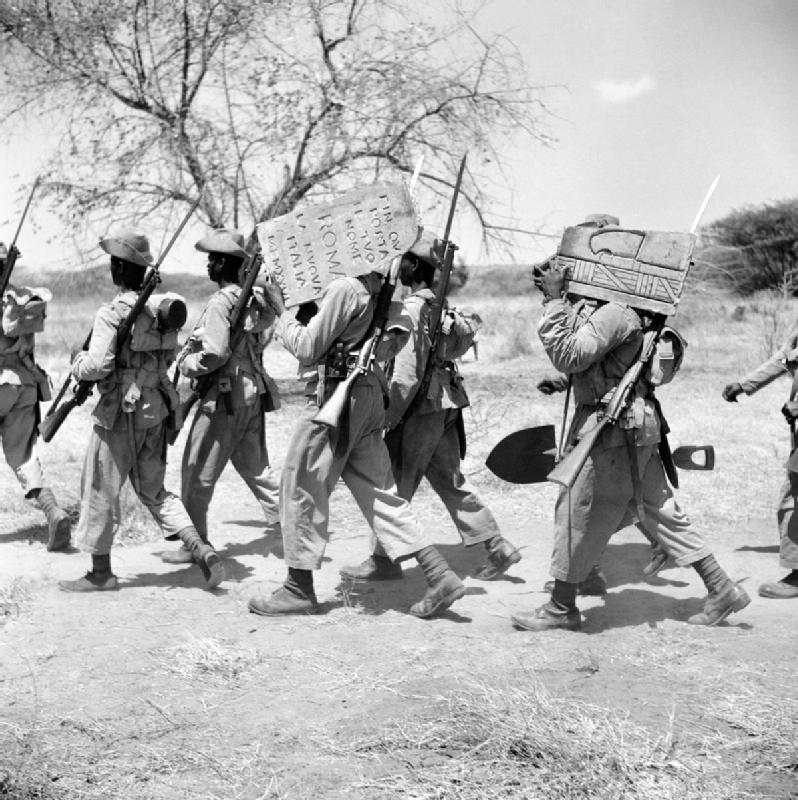
Colonial authorities reinforced this perception of recruitment as a new form of slavery by the use of propaganda and psychological tactics to mask exploitation. These campaigns were carefully planned and adjusted to fit the concerns and values of different audiences, whether they lived in cities or rural areas. Propaganda emphasized ideas like duty, loyalty, fear of Axis domination, and personal benefits to convince African men to join the war effort.
In cities, colonial authorities focused on the global importance of the war and the need to protect African communities. For example, British officials in Nigeria worked with leaders like Nnamdi Azikiwe (who later became the first President of the country after independence from Britain) to promote the idea that enlisting would help stop the Axis powers from expanding and oppressing Africans. Azikiwe made speeches arguing that African involvement in the war was necessary to protect their future. Large public events were another mechanism used to spread this message. In 1939, a rally in Lagos, Nigeria, attracted nearly 10,000 people. Traditional rulers and colonial officials gave speeches about the need to fight against Germany and Italy, emphasizing the danger of what might happen if the Allies lost. These events combined patriotic slogans with warnings, using fear and appeals to duty to persuade people. In French colonies, officials used similar strategies for their urban propaganda. Officials organized parades and public meetings, and they distributed posters and newsreels that celebrated the contributions of African soldiers. French propaganda often promised rewards like pensions, education, or even French citizenship to recruits, though these promises were rarely kept.
Fear induced by propaganda was also used as a powerful motivator. In Kenya, recruiters warned villagers that if the Germans won, they would take over African lands and reintroduce slavery. This fear resonated strongly in communities where the history of the transatlantic and Arab slave trades was still fresh. Sergeant R. Moloi, a South African, enlisted “ because I did not want to be a slave in this country; because these people told us that this enemy is a very bad enemy – he is a bad man – Hitler –when we can win this war we would be slaves, especially as black people”. One Kenyan explained his reason for enlistment: “we had been told that unless we joined up and helped the Government, Kenya would be occupied by Germans and Italians. To keep out these “monsters,” and also to escape the boredom and difficulty of being unemployed in Nairobi, I enlisted.” These fear-based messages often left young men feeling they had little choice but to enlist.
Colonial propaganda in rural areas also appealed to cultural values like masculinity and bravery. Recruiters presented military service as a way for young men to prove their courage and gain respect in their communities. They used songs and stories to celebrate soldiers as protectors and heroes. In Ghana, for example, local songs praised men who joined the war, linking their service to traditional ideas of honor and strength.
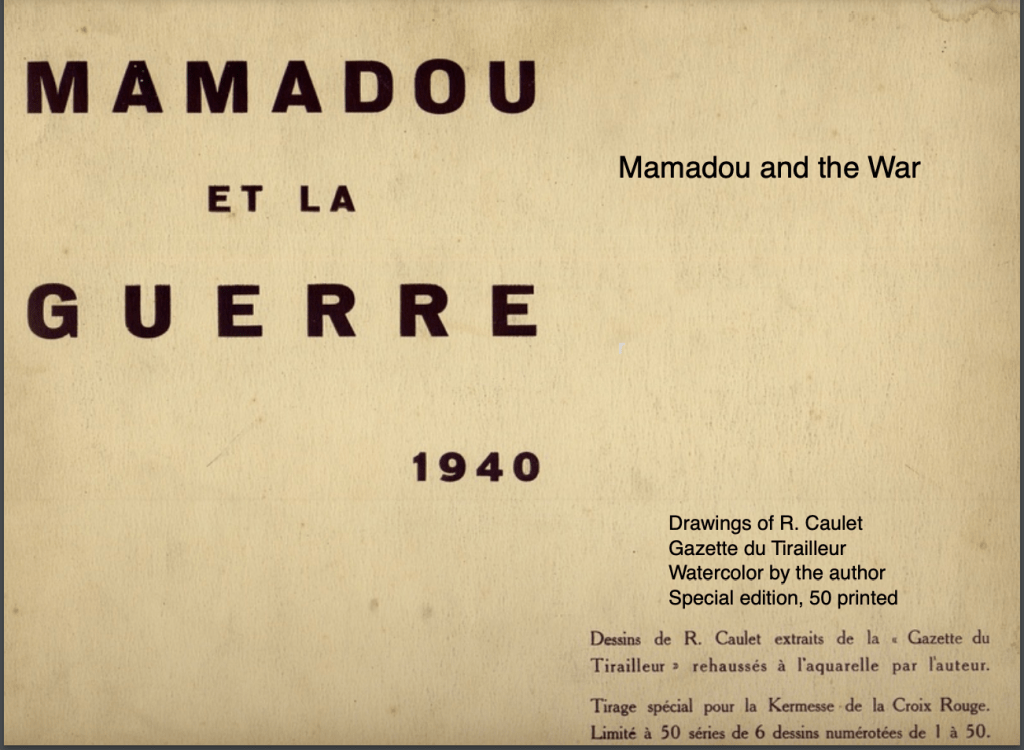
Propaganda also spread through newspapers, films, and posters. In urban areas, cinemas played newsreels showing African soldiers fighting alongside Europeans, while posters depicted soldiers as well-dressed and respected members of their communities. Between January and June 1940, the French Colonial Army in Senegal published “La Gazette du Tirailleur”, an anti-German news journal. “Mamadou s’en va-t’en guerre” (“Mamadou Goes to War”) was a comic strip published biweekly, and the adventures of the main character, a fictional African soldier, focused on wartime themes such as France’s military objectives, Nazi aggression and its ambitions in Africa, and the vital role Africans were expected to play in defending the French empire. In East Africa, the colonial authorities published “A Spear for Freedom”, a picture-book with short captions in English and in the languages of the region showing how an African cattle-herder became a soldier in the British army. This tactic would have been effective for illiterate Africans and those who did not speak English, encouraging those distant from Europe to join a foreign war with little understanding of its purpose.
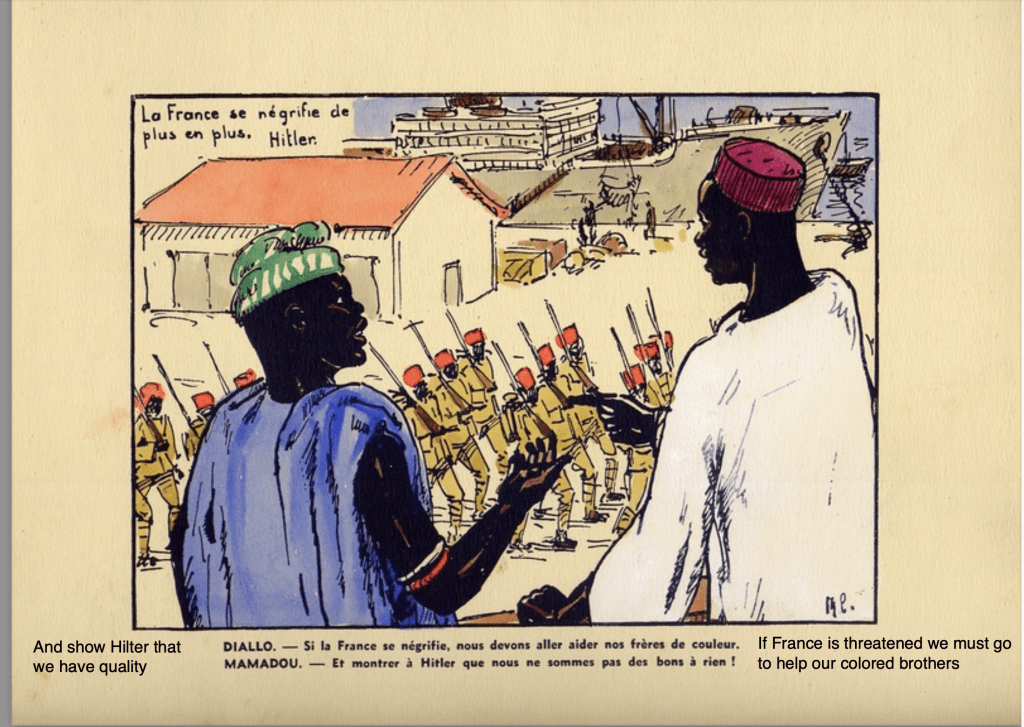
Colonial propaganda played a major role in recruitment, alongside coercion. It was designed to address the specific concerns of urban and rural communities, using ideas of duty, fear, and rewards to persuade African men to enlist. However, the promises made through propaganda were not usually kept, leaving many soldiers disillusioned. While propaganda was effective in securing recruits, it also contributed to the resentment and mistrust that led to anti-colonial movements after the war.
Economic and social pressures
Beyond direct coercion, colonial authorities also exploited economic desperation and social structures to ensure high enlistment rates. High taxes, forced labor, and reliance on cash crops like cocoa, cotton, and groundnuts made many communities dependent on the global market. When the war disrupted trade, economic conditions worsened. Unemployment rose, food shortages became common, and many families struggled to survive. Colonial authorities forced civilians to farm, mine, and build roads and railways. To meet war demands, colonial governments reduced what the locals could consume, raised taxes, and set quotas on how much should be produced, often using force when targets were not met. During World War II, African exports surged, supplying food, minerals, and raw materials like rubber, cotton, and metals needed for weapons. This production relied on forced labor, often causing food shortages and famine.
In these difficult economic conditions, joining the military seemed like the only way for many African men to earn a steady income. Soldiers were promised regular wages, food, and clothing, which were hard to come by in civilian life. Recruits also learned new skills that could provide work for them even after the war had ended. In Kenya, higher wages and the social status that soldiers (askaris) enjoyed meant that there were always many who wished to join the King’s African Rifles (KAR). Waruhiu Itote, a recruit, said that he had enlisted “[t]o escape the boredom and difficulty of being unemployed in Nairobi”, and Bildad Kaggia, a recruitment clerk, shared that: “There was no other employment in the district” and “The army provided jobs which could not be found in civilian life.” In Nigeria, 16-year-old Isaac Fadoyebo was a typical one – he voluntarily signed up to be recruited without his parents’ knowledge “because the pay of one shilling per day was twice a school-teacher’s pay.” The inter-war period had created conditions that now forced many young men to choose enlistment in order to survive.
Colonial governments also used financial incentives to attract recruits. British colonies offered enlistment bonuses, though they were often small. For example, Nigerian recruits received a small payment upon signing up, along with promises of regular pay during their service. While these wages were low compared to those of European soldiers, they were still better than what many Africans could earn in their struggling economies. Brands concludes: “High wages, new clothes, medical care and food beyond what many unskilled workers could otherwise afford were thus chief incentives to join the army.” The African soldiers did their duties despite “the failure of the military to be bound by its promise of the prospect of higher pay for African personnel.”
Rather than operating independently, social pressure, economic necessity, and coercion reinforced one another, ensuring a steady supply of recruits for colonial armies. Social pressure played a big role in recruitment. Colonial governments worked closely with chiefs, elders, and religious leaders to encourage enlistment. They used their influence to persuade or pressure young men into joining. In many African cultures, military service was framed as a test of masculinity and bravery. Parsons refers to an example in Kenya where a man who refused to enlist was forced to dress in women’s clothes and walk in front of a crowd.
There were many reasons why African soldiers were recruited. Colonial powers employed both forceful tactics and promises of opportunity to meet their military demands, while some Africans saw enlistment as a way to earn money and escape severe poverty, seizing the opportunity for a stable income and a sense of purpose amidst widespread economic hardship. Combined with social expectations, these challenges pushed men toward military service as one of the few available options. It should be remembered that around 90% of British African colonial soldiers were not literate. Many were drawn from areas governed by indigenous authorities that operated outside the cash-based economy. As Killingray argues, these conditions created a body of soldiers who lacked personal autonomy. This loss of autonomy, created largely by colonial rule, challenges the idea that enlistment was truly voluntary.
Select Sources
image: No 1 Army Film & Photographic Unit, Clements H J (Lt), Public domain, via Wikimedia Commons
image: excerpt from Mamadou and the war by Robert Caulet
Echenberg, Myron. “‘Morts Pour La France’; The African Soldier in France During the Second World War.” The Journal of African History 26, no. 4 (1985): 363–80. http://www.jstor.org/stable/181655.
Echenberg, Myron. Colonial Conscripts: The Tirailleurs Sénégalais in French West Africa, 1857–1960. Portsmouth, NH: Heinemann, 1991.
Ginio, Ruth. The French Army and Its African Soldiers: The Years of Decolonization. Lincoln: University of Nebraska Press, 2017
Ginio, Ruth. “African Soldiers, French Women, and Colonial Fears during and after World War II.” Chapter. In Africa and World War II, edited by Judith A. Byfield, Carolyn A. Brown, Timothy Parsons, and Ahmad Alawad Sikainga, 324–38. Cambridge: Cambridge University Press, 2015.
Grundlingh, Louis. “Aspects of the Impact of the Second World War on the Lives of Black South African and British Colonial Soldiers.” Transafrican Journal of History 21 (1992): 19–35. Accessed June 8, 2024. http://www.jstor.org/stable/24520418.
Hargreaves, John D. Decolonization in Africa. London: Routledge, 2014.
Headrick, Rita. “African Soldiers in World War II.” Armed Forces & Society 4, no. 3 (1978): 501–26. Accessed June 8, 2024. http://www.jstor.org/stable/45346089.
Israel, Adrienne M. “Measuring the War Experience: Ghanaian Soldiers in World War II.” The Journal of Modern African Studies 25, no. 1 (1987): 159–68. Accessed January 8, 2025. http://www.jstor.org/stable/160973.
Killingray, David. “Military and Labour Recruitment in the Gold Coast During the Second World War.” The Journal of African History 23, no. 1 (1982): 83–95. Accessed June 8, 2024. http://www.jstor.org/stable/181272.
Killingray, David. “Labour Exploitation for Military Campaigns in British Colonial Africa 1870-1945.” Journal of Contemporary History, Vol. 24, No. 3 (1989): 483-501Accessed December 19, 2024.
http://www.jstor.org/stable/260671.
Killingray, David. “The ‘Rod of Empire’: The Debate over Corporal Punishment in the British African ColonialForces, 1888-1946.” The Journal of African History, Vol. 35, No. 2 (1994): 201-216. Accessed January 20, 2025. http://www.jstor.org/stable/183216
Killingray, David, and Martin Plaut. Fighting for Britain: African Soldiers in the Second World War. Suffolk, UK: Boydell & Brewer, 2010.
Killingray, David. “African Military Migration in the First and Second World Wars.” Migration in Africa, 2022, 311–29.
Losh, Jack. “Britain’s Violent Conscription of African Soldiers Is Finally Coming to Light.” New Statesman, March 4, 2019. Updated September 9, 2021. Accessed December 17, 2024. https://www.new.com/politics/2019/03/britains-violent-conscription-of-african-soldiers-is-finally-coming-to-light.
 WORLD WAR II'S UNSUNG AFRICAN HEROES
Leave a comment