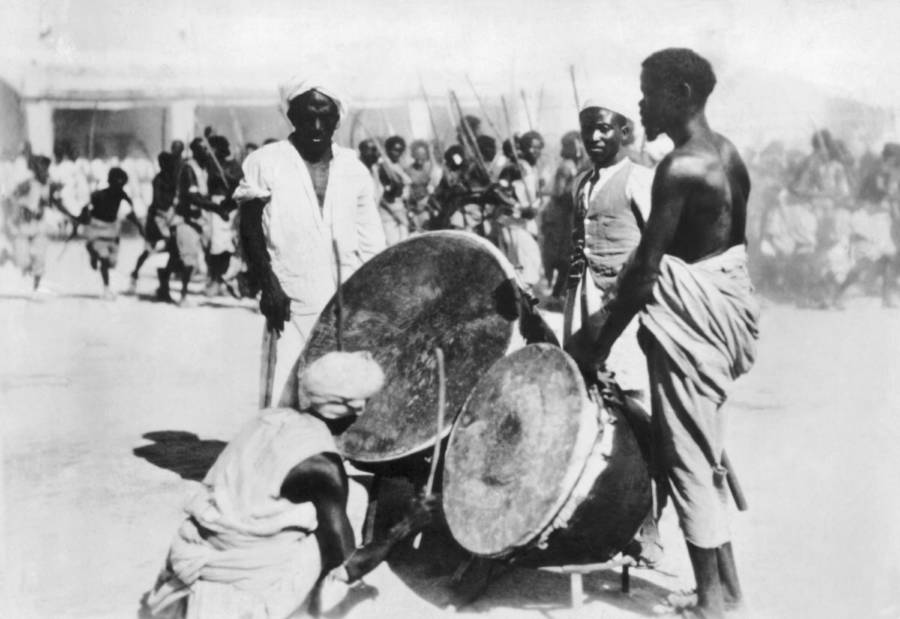
This post is retrospective, with a birds eye view at what was happening Post WWI and Pre WWII as it related to the colonial soldiers.
European powers, including England, Italy, and France, began reorganizing and expanding their colonial armies during this period. These forces typically comprised African soldiers under the command of European officers. The colonial administrations intensified their recruitment and training efforts, often utilizing these soldiers for internal security and to assert colonial dominance. From 1930 onwards, soldiers from all parts of British colonial Africa and South Africa (who were more independent than other African nations) were employed in combatant and noncombatant roles, and later in WWII were used against Italian, German, and Vichy French forces.

The British cavalry charges into battle during the North African Campaign, circa 1940-1943
https://allthatsinteresting.com/african-soldiers-world-war-ii#12
African Soldiers Efforts Pre WWII and Exploitation
After World War I and in the time before World War II, African French colonial soldiers spent time occupying the Rhineland, an area in Germany bordering France and under the control of France, (after the Versailles Treaty of 1919) which was rich in natural resources. According to historians David Killingray and Martin Plaut in their book *Fighting for Britain*, it “could be argued that for Africans, [the Second World War] started when Italy invaded Abyssinia in 1935” (7). Killingray and Plaut go on to explain that the Italian army had a 60,000-person strong army in Eritrea, an Italian colony at the time.
What is less known is that this was “exploitation of the colony’s limited resources […] out of a male productive labor force of only 150,000, more than 40 percent were under arms.” This statistic highlights the extent to which the colonial powers drained the colony’s resources, particularly its human labor force. The colony’s economic and productive capacity was severely diminished by conscripting such a significant portion of the male population into military service. This exploitation not only weakened the colony’s ability to sustain itself but also demonstrated the colonial powers’ disregard for the well-being and development of their colonies and the people of said colonies. In other colonial nations like Belgium, they maintained a peacetime army called the Force Publique, or Public Force, which was composed of 18,000 men and primarily used for internal security.
Fear and Misinformation Among African Soldiers and Civilians at the Start of the War
The confusion and fear experienced by African civilians at the outbreak of World War II is highlighted on several occasions. Soldiers who fought for the British during the war described the terror around them. “The day war broke out, 3 September 1939, was an ordinary day, a day like today,” said Robert Kakembo from Buganda (a Bantu kingdom within Uganda, a former British colony). “Most tribes in East and Central Africa did not know what the trouble was about.” Another soldier, Josiah Mariuki, a Gikuyu (a Kenyan tribe), recalled that “there was an ominous rumour that Hitler was coming to kill us all and many people went fearfully down to the rivers and dug holes in the bank to hide from the troops”. For average civilians, many remembered the Great War twenty five years prior and went into hiding. Robert Kakembo’s statement reflects the ordinary nature of the day when war was declared, emphasizing the sudden and unexpected disruption of daily life.
African colonial soldiers were never treated like “soldiers,” but rather like tools. Even during their recruitment, they were lured into fighting without truly knowing what they were fighting for. Historian Rita Headrick, who wrote African Soldiers in World War II believes that the reasons why individuals volunteered are an important area that still requires investigation. Although some doubted that Africans comprehended the international context, they believed that Africans were fighting for King George, the local missionary, or because they favored the English over other Europeans. One Kenyan explained his enlistment as follows: “Then we had been told that unless we joined up and helped the Government, Kenya would be occupied by Germans and Italians. To keep out these “monsters,” and also to escape the boredom and difficulty of being unemployed in Nairobi, I enlisted.” (Headrick, 505). The lack of understanding among tribes in East and Central Africa about the reasons behind the conflict underscores the disconnect between the African colonies and the European powers.
These recollections of people hiding in fear from the supposed threat of Hitler reveals the spread of misinformation and the anxiety among the population. All the fear and confusion were compounded by memories of the Great War, leading many to take drastic measures to protect themselves, showing the profound impact of global conflicts on colonial territories and their inhabitants.
Cover Image: Ethiopian villagers sound the war drums to gather troops to fight the invading Italians, Ethiopia, circa 1935 https://allthatsinteresting.com/african-soldiers-world-war-ii#6
 WORLD WAR II'S UNSUNG AFRICAN HEROES
Leave a comment