The Major Players and Unsung Heroes of WWII
World War II was the deadliest war in human history. The war was fought between the Allies, including the key powers France, The United States, The Soviet Union, and the United Kingdom, and the Axis, composed of Japan, Germany and Italy. The Allies ultimately prevailed in what is now a familiar story. However, what is far less widely known is that their victory came thanks in part to a large group of unsung heroes: colonized soldiers. Both France and the United Kingdom drew thousands of soldiers from their African colonies, young men whose valiant efforts have been left unrecognized for far too long.
The African Contribution to the French War Effort
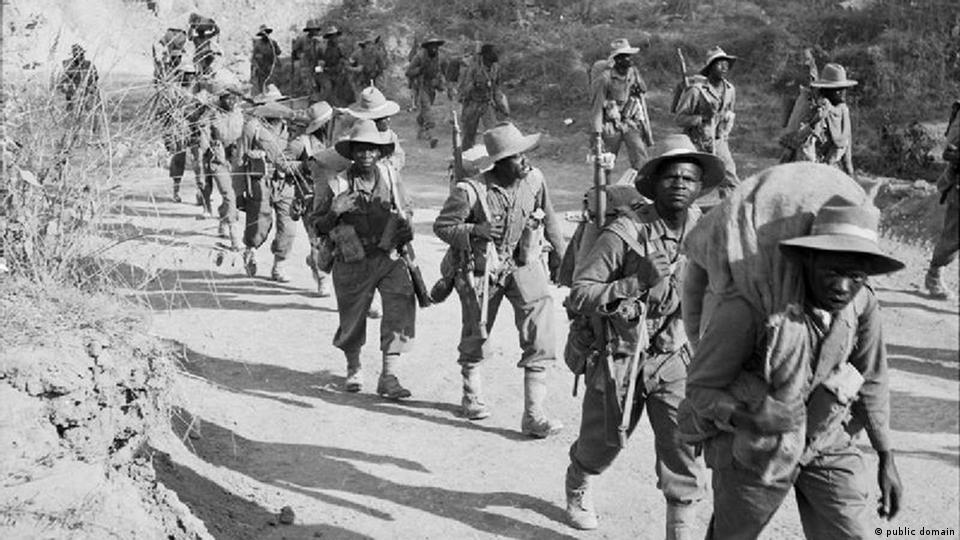
To reinforce their armed forces, the colonial powers, such as France and Britain, enlisted soldiers from their African colonies. Even from the moment war broke out in Europe, African soldiers were already fighting for their colonial masters. African colonial soldiers numbered in the hundreds of thousands and contributed significantly during World War II in many different ways. According to historian John H. Morrow, from 1939 to June 1940, the French Military called up approximately 300,000 North African and 197,000 West African men to join the war effort on the frontlines. When the Germans invaded mainland France, about 75,000 Senegalese soldiers were stationed throughout France. About 63,300 West Africans saw combat in France in 1940 (Morrow, 14). After the Allies invaded North Africa in 1942, France called up even more Africans to join the army, and almost half the Free French forces were African (Headrick, 510). Without the manpower of the colonial soldiers, France may have capitulated much faster and possibly never have regained their freedom.

De Gaulle with African Troops
Britain’s Reliance on African Colonies
The United Kingdom had the most African colonies, and similar to the French army, Britain relied on them heavily to support the war effort. According to historian Rita Headrick, “Under General Sir George Giffard,the RWAFF (Royal West African Frontier Force) grew from 50,000 in 1941, to 100,000 in 1942, to 150,000 in 1945” (Headrick, 503-504). Overall, more than 200,000 West Africans risked their lives under British command. In East Africa, participation in the armed forces was even higher. Approximately 325,000 East Africans served in both the KAR (King’s African Rifles) and various military labor units (Headrick, 504).

Senegalese Soldiers at Camp
The Harsh Reality: African Soldiers as Tools
Although statistics on French and British recruitment from their African colonies prove that African colonial soldiers had a major impact on the war effort, they were never treated like ‘soldiers’, but rather like tools. Even during their recruitment, they were lured into fighting without truly knowing what they were fighting for. Historian Headrick writes, “the motivations of those who volunteered is a crucial area which remains to be investigated. While unwilling to concede that Africans understood the international situation, they nevertheless assured themselves that Africans were fighting for King George, the local missionary or because they preferred Englishmen to other Europeans” (Headrick, 504). The primary reasons Africans ended up enlisting were better food, money, and education. One Kenyan explained his enlistment as follows: “Then we had been told that unless we joined up and helped the Government, Kenya would be occupied by Germans and Italians. To keep out these “monsters,” and also to escape the boredom and difficulty of being unemployed in Nairobi, I enlisted.” (Headrick, 505) This shows that colonial soldiers simply wanted basic human necessities, which they struggled to get just because of the color of their skin. What’s more, these soldiers were encouraged to fight to avoid being oppressed by the European “monsters” from Germany and Italy, when in fact they were already oppressed under the current European colonial rulers.

Red Ball Express Members Before D-Day
The Quest for Recognition and Respect
Even now, almost 70 years after the end of the war and nearly 60 years after the end of colonial rule, African colonial soldiers lack sufficient recognition and repayment for their efforts, despite the fact that they made up a large part of European armies and were crucial to their success. Who were these colonial soldiers and what are their stories? What made them agree to fight for their colonial rulers? Were they ever fairly compensated for risking their lives for a foreign power? What happened to them after the war? Were they given the respect that a soldier deserves?
SOURCES
MORROW, JOHN H. “Black Africans in World War II: The Soldiers’ Stories.” The Annals of the American Academy of Political and Social Science 632 (2010): 12–25. http://www.jstor.org/stable/27895945.
HEADRICK, RITA. “African Soldiers in World War II.” Armed Forces & Society 4, no. 3 (1978): 501–26. http://www.jstor.org/stable/45346089.
 WORLD WAR II'S UNSUNG AFRICAN HEROES
Leave a comment